Gyeongju Without a Car: Bulguksa, Seokguram and a Night Walk from Cheomseongdae to Wolji Pond (2026)
For almost a thousand years, Gyeongju was the capital of the Silla kingdom, and the city still wears that history openly. Grass-covered royal tombs rise beside ordinary streets, a 7th-century stone observatory stands in an open field, and two of Korea’s greatest pieces of Buddhist architecture sit in the hills just outside town. This route covers the essentials in one long day by bus and on foot, from Bulguksa Temple in the morning to Wolji Pond after dark.
At a glance
| Getting there | KTX from Seoul Station or SRT from Suseo to Gyeongju Station, about 2 to 2.5 hours; about 30 minutes by KTX from Busan |
| Getting around | City buses 10, 11, 12 and 700, plus walking downtown; taxis are inexpensive for short hops |
| Bulguksa and Seokguram | Free entry |
| Donggung Palace and Wolji Pond | 09:00–22:00 (last entry 21:30); adults 3,000 won |
| Time needed | A full day; better with one night in town |
| Best for | Architecture, history, night photography |
Getting to Gyeongju and around
High-speed trains stop at Gyeongju Station (경주역), which was called Singyeongju Station until 2021 and sits outside the historic center. From there, bus 700 runs to Bulguksa in about an hour, and several buses head downtown. Book trains on the Korail or SRT website, and leave plenty of time for your return; it is easy to linger longer than planned.
Downtown, buses 10 and 11 are the workhorses. They leave from the stops by the Gyeongju Intercity and Express Bus Terminals, loop in opposite directions and both reach Bulguksa. From Bulguksa, bus 12 climbs to Seokguram, but it runs only about once an hour; if you just miss it, a taxi up the mountain road takes about 20 minutes. Tap a T-money or other transport card on every bus.
The route
| Time | Stop |
|---|---|
| 09:30 | Bulguksa Temple |
| 11:30 | Seokguram Grotto (bus 12 from Bulguksa) |
| 14:00 | Lunch and Hwangnidan-gil, back downtown |
| 15:30 | Daereungwon royal tombs |
| 17:30 | Cheomseongdae as the lights come on |
| 18:30 | Donggung Palace and Wolji Pond after dark |
09:30 Bulguksa Temple (불국사)
Bulguksa was completed in the 8th century as an image of the Buddhist paradise built in stone and wood, and together with Seokguram it was listed as a UNESCO World Heritage Site in 1995. Start at the front, where two pairs of stone stairways, Cheongungyo and Baegungyo, climb a massive stone terrace to the main gate. Inside, look for the two pagodas in the main courtyard: the ornate Dabotap, which appears on the 10-won coin, and the plain, perfectly proportioned Seokgatap beside it. Entry is free. Arrive early; tour groups fill the courtyards by late morning.
A local’s tip: Bulguksa and Seokguram are the two places everyone visits in Gyeongju, and for good reason. They are UNESCO World Heritage Sites more than a thousand years old, and there is no better place to experience the architecture of Korea’s Silla period in person.
11:30 Seokguram Grotto (석굴암)
Take bus 12 from the Bulguksa stop up Tohamsan mountain, then walk about 15 minutes along a forest path to the grotto. Seokguram is not a natural cave: it is an artificial chamber built from cut granite, with a domed ceiling, around a seated Buddha facing east toward the sea. Today you see the Buddha through a glass screen that protects it, so the visit itself is short, but the setting and the walk are part of the experience. Entry is free.
14:00 Hwangnidan-gil and lunch
Ride bus 10 or 11 back downtown and get off near Hwangnidan-gil, a street of low hanok-style buildings filled with cafes, bakeries and small restaurants. It is the easiest place for a late lunch. Look for Gyeongju bread (gyeongju-ppang), small pastries filled with sweet red bean, sold all over town.
15:30 Daereungwon royal tombs (대릉원)
A short walk from Hwangnidan-gil, Daereungwon is a park of huge grassy burial mounds, the tombs of Silla kings and nobles. The park itself is free to walk through. Inside, Cheonmachong is the one tomb you can enter, with a small exhibition about what was found inside, including the gold crown and the painted “heavenly horse” that gave it its name. Please stay on the paths; climbing the mounds is not allowed.
Evening: Cheomseongdae and Donggung Palace and Wolji Pond
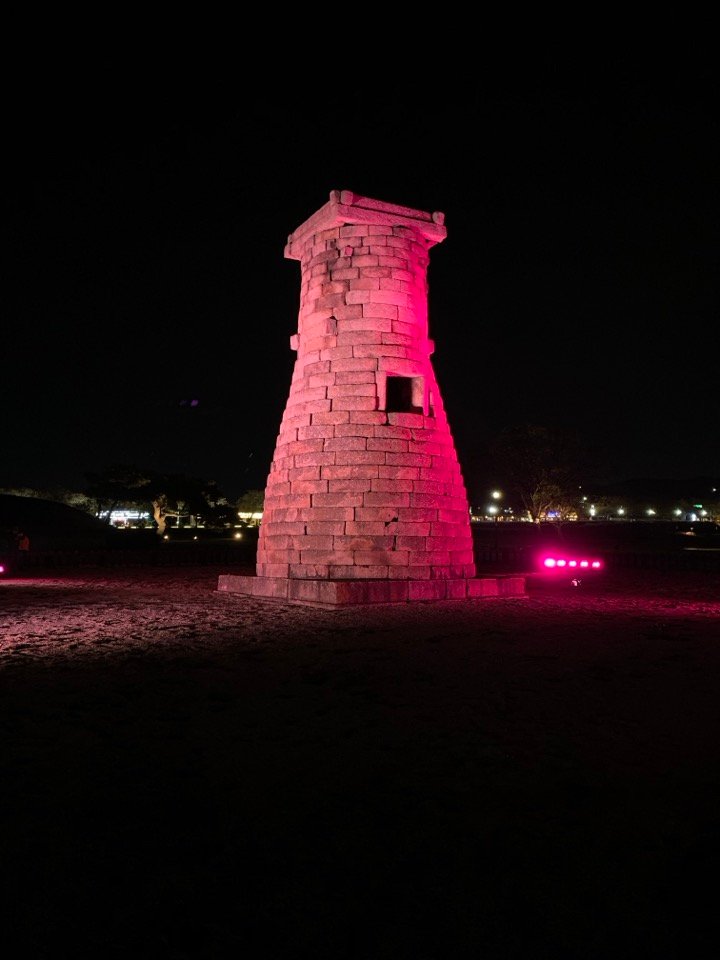
Save your energy for the evening, because Gyeongju is at its best after dark. Cheomseongdae (첨성대), a bottle-shaped stone observatory from the 7th century, stands in an open field just east of Daereungwon and is lit at night. From there, walk about 15 to 20 minutes through the fields to Donggung Palace and Wolji Pond (동궁과 월지), the site of a Silla royal palace and garden. Its restored pavilions are floodlit at night and reflected almost perfectly in the still water, which makes this the most photographed view in the city.
A local’s tip: Visit Cheomseongdae and Donggung Palace and Wolji Pond at night. The lights are beautiful, and the walk between them is one of the nicest evening strolls in Korea.
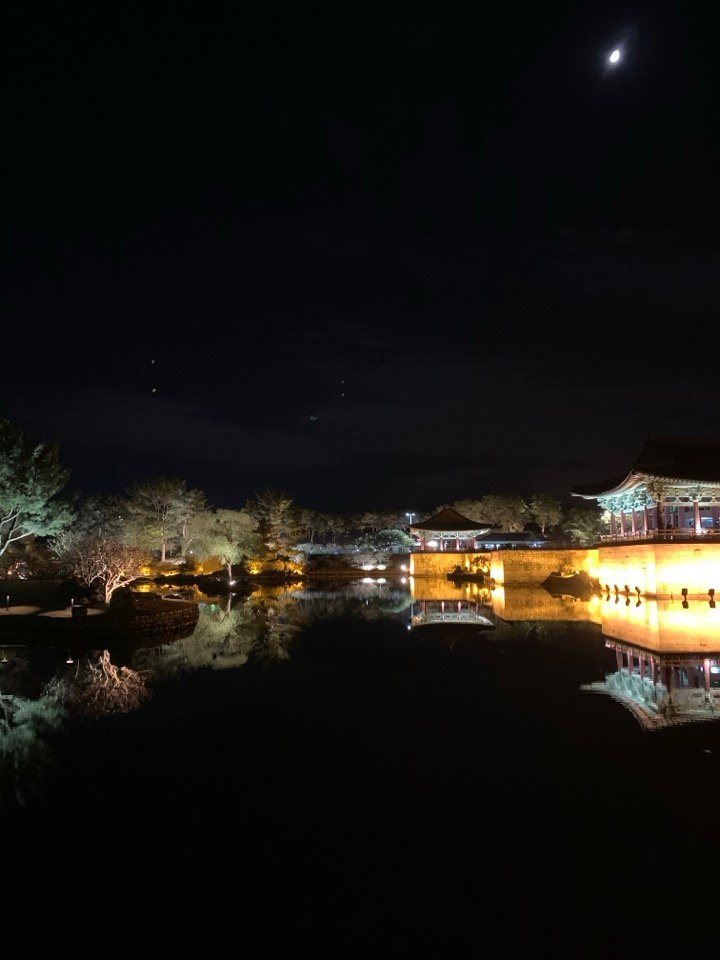
Donggung Palace and Wolji Pond is open 09:00 to 22:00, with last entry at 21:30, and costs 3,000 won for adults. Arrive just after sunset, while there is still some blue in the sky, for the best photos.
Why Silla architecture is worth seeing in person
Most of Korea’s historic wooden buildings have burned and been rebuilt many times, so stone is where you meet the Silla builders directly. At Bulguksa, notice how the stone terrace is built: large, roughly shaped boulders at the bottom, locked together with precisely cut blocks above, so the structure works with the natural stone instead of hiding it. The two pagodas stand side by side as a lesson in contrast, one richly decorated and one almost severe in its simplicity.
Seokguram goes further. Its builders assembled hundreds of granite pieces into a domed chamber, scaled the space so the Buddha sits at its visual center, and placed the grotto to face the sunrise over the East Sea. Standing in front of it, you are looking at engineering and proportion that still feel deliberate more than 1,200 years later.
One day or overnight?
This route is possible as a long day trip, but Gyeongju rewards an overnight stay. Sleeping near Hwangnidan-gil means you can enjoy the night views without watching the clock for the last train, and the next morning you can add Gyochon Hanok Village, Woljeonggyo Bridge or the Gyeongju National Museum. A hanok guesthouse in the old center suits the city well.
Tips for a smooth day
- Start with the hills. Bulguksa and Seokguram are busiest from late morning; going first also leaves the evening free downtown.
- Check the bus 12 timetable at the Bulguksa stop before you go up, so you know when the next bus comes back down.
- Bring a layer. Seokguram is in the mountains and Wolji Pond is by the water, and both feel colder than downtown.
- Save the Korean names 불국사, 석굴암, 대릉원, 첨성대 and 동궁과 월지 in Naver Map or KakaoMap for live bus times. Our maps app guide explains how.
Frequently asked questions
Can I visit Gyeongju without a car?
Yes. Buses 10 and 11 link downtown with Bulguksa, bus 12 continues to Seokguram, and the main downtown sights are within walking distance of each other.
Are Bulguksa and Seokguram free?
Yes, entry to both is free. You pay only for the bus or taxi to get there.
When is the best time to see Wolji Pond?
Just after sunset, when the pavilions are lit and the sky still has some color. It stays open until 22:00, with last entry at 21:30.
Is Gyeongju a good day trip from Busan?
Very good: the KTX from Busan takes about 30 minutes. See our one-day Busan itinerary to plan the other side of the trip.
For official information, see the Gyeongju city tourism website. For another historic city with a different character, read our Jeonju Hanok Village guide.
Information reviewed: November 24, 2026. Bus routes, opening hours and fees change; confirm them before you travel.