One Day in Busan: Jagalchi, Nampo-dong and Gamcheon Culture Village Itinerary (2026)
Busan is a big, spread-out city, but its old port is compact enough to see in a single long day. This route stays on one side of town, along Metro Line 1: Korea’s most famous fish market, the street-food lanes of Nampo-dong, a hilltop park with harbor views, and the painted hillside of Gamcheon Culture Village. It works whether you are coming down from Seoul on the KTX or spending your first day in Busan before heading to the beaches.
At a glance
| Getting there | KTX from Seoul Station to Busan Station, about 2.5 hours; SRT from Suseo Station in southern Seoul, about 2 hours 20 minutes |
| Getting around | Metro Line 1 for everything except Gamcheon, which is a short village-bus ride from Toseong Station |
| Entry fees | Free for the markets, Yongdusan Park and Gamcheon; Busan Tower and the Gamcheon stamp map are optional extras |
| Time needed | 7 to 8 hours on the ground |
| Best for | Seafood, street food, harbor views, photography |
Getting to Busan
The KTX from Seoul Station to Busan Station is the simplest option for most visitors, especially if you are staying around Myeongdong, Hongdae or Seoul Station. If your hotel is in Gangnam or Jamsil, the SRT from Suseo Station is often closer and slightly cheaper. Both arrive at Busan Station, which sits at the northern end of this route. Book both directions in advance on the Korail or SRT website, since weekend and holiday trains sell out.
For a day trip from Seoul, a train arriving around 10:30 and a return after 18:00 gives you enough time. If you have luggage, leave it in the coin lockers at Busan Station before you start. You will not want it on Gamcheon’s stairs.
The route
| Time | Stop |
|---|---|
| 11:00 | Jagalchi Market, with a seafood lunch |
| 12:45 | BIFF Square street food and Gukje Market |
| 13:45 | Yongdusan Park and its harbor view |
| 14:45 | Gamcheon Culture Village |
| 17:30 | Back to Busan Station for dinner and your train |
11:00 Jagalchi Market
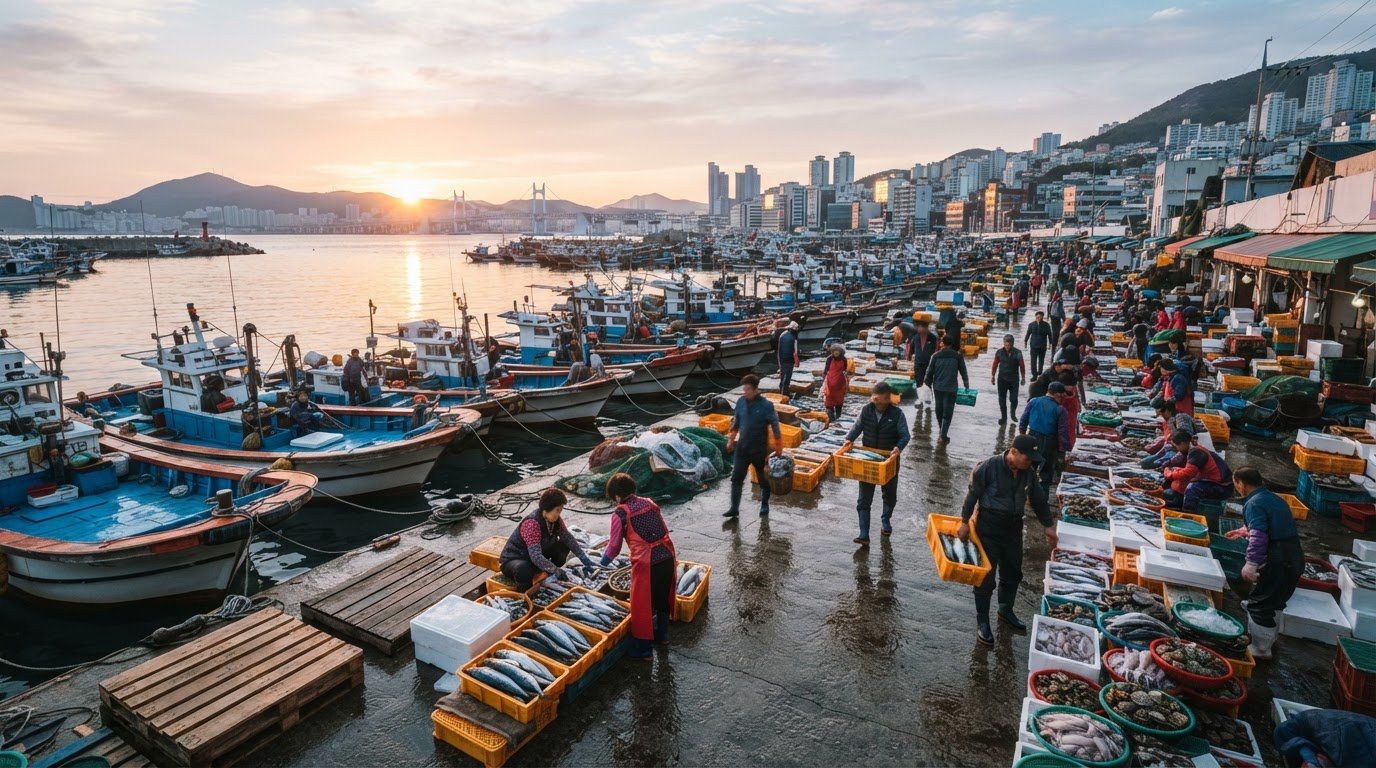
Take Line 1 to Jagalchi Station and follow the signs to the waterfront. Jagalchi is Korea’s best-known seafood market: outdoor stalls line the harbor road, and the main market building rises above them like a wave. Inside, the system is simple once you know it.
- Buy on the first floor. Walk the tanks, compare two or three stalls and agree on a price before anything is prepared. Many stalls show prices; if not, ask.
- Eat on the second floor. The vendor will send your seafood up to a partner restaurant, where it is sliced, steamed or grilled for you.
- Pay the restaurant separately. Expect a table setting fee of about 5,000 won per person for side dishes and sauces, plus a cooking charge of roughly 5,000 to 10,000 won per dish. A spicy fish stew (maeuntang) made with the leftover bones costs extra.
A local’s tip: I lived in Busan for several years, and here is the one phrase I would teach any visitor. Busan Korean has its own friendly accent, and one of its signatures is ending a sentence with “-ye” (예). So instead of the standard “How much is this?”, try “Igeo eolmaingaye?” (이거 얼마인가예?). Even a slightly clumsy attempt makes market vendors light up. Busan people love it when a visitor speaks their way, and in my experience you will be treated warmly, with no tourist pricing.
Before you leave, take the elevator to the rooftop observation deck for a free view over the harbor and Yeongdo Island. The market is closed on the first and third Tuesday of each month. Not a seafood fan? Walk the floor for twenty minutes and eat in Nampo-dong instead.
12:45 BIFF Square and Gukje Market
Walk five minutes inland to BIFF Square, named after the Busan International Film Festival that began here before moving to Haeundae. Look down for the handprints of actors and directors set into the pavement, then look up for the food carts. The one to try is ssiat hotteok, a fried pancake split open and stuffed with sunflower seeds, pumpkin seeds and peanuts. Busan’s fish cakes (eomuk), sold on skewers in hot broth, are the other classic snack.
Just north is Gukje Market, a dense grid of covered lanes that grew out of the refugee trading stalls of the Korean War. Today it sells everything from kitchenware to clothing. It is a good place to wander if the weather turns.
13:45 Yongdusan Park
From Gwangbok-ro, the main shopping street, an outdoor escalator carries you up to Yongdusan Park. The park is free and gives you the best easy view of the working port, with container ships moving in and out below. Busan Tower, now branded Busan Diamond Tower, stands at the top; its observatory charges admission and is open from 10:00 to 22:00. If you are short on time, the free view from the park itself is enough.
14:45 Gamcheon Culture Village
Ride Line 1 two stops west from Nampo to Toseong Station and leave by Exit 6. From the stop nearby, take village bus Saha 1-1, Seo-gu 2 or Seo-gu 2-2 up the hill and get off at Gamjeong Elementary School (감정초등학교). The ride takes about 15 minutes, and the village entrance is a five-minute walk. A taxi from Toseong is quick and inexpensive if you are in a group.
Entry is free. Stop at the information center near the entrance and buy the stamp map for about 2,000 won: it marks a walking route through the lanes, with stamp points at viewpoints, small galleries and art installations. Allow two to three hours, wear good shoes, and keep a little energy in reserve, as the walk back up is steeper than it looks.
- Gamcheon is a neighborhood where people live. Keep to public lanes, and do not open gates or step into courtyards.
- Keep your voice down, especially in the narrow upper alleys.
- Do not block stairways for photos; residents carry shopping up and down these steps every day.
Why Gamcheon looks the way it does
Gamcheon grew in the 1950s, when refugees from the Korean War settled on the steep slopes outside the city and built small houses wherever the land allowed. What looks random from below is surprisingly orderly up close. The houses step down the hill in terraces, roughly one row above the next, so that most homes keep a view and some sunlight instead of sitting in the shadow of their neighbors. Narrow stairways and lanes run along the contours to tie the terraces together.
By the 2000s the village was aging and emptying. In 2009 an art project brought artists in to paint walls and turn empty houses into small galleries, which is how the pastel colors and the famous murals arrived. As you walk, look past the paint at the structure underneath: how small the footprints are, how the rooftops double as terraces, and how the whole hillside works as a single, self-built neighborhood.
17:30 Back to Busan Station
Take the village bus back down to Toseong and ride Line 1 north to Busan Station, about 10 minutes. The streets around the station are a good place for two Busan specialties: dwaeji gukbap, a rich pork and rice soup, and milmyeon, chewy cold noodles that Busan made its own after the war. Leave at least an hour between dinner and your train, including time to collect your bags.
A shorter route
With luggage, a stroller or a tight train time, keep to the flat, walkable core: Jagalchi Market → BIFF Square → Gukje Market → Yongdusan Park. That is a full, relaxed half day, and you can save Gamcheon for another visit.
Tips for a smooth day
- Avoid the first and third Tuesday if Jagalchi is your priority.
- Carry some cash. Most places take cards, but small street-food carts and older market stalls may prefer cash.
- Use Naver Map or KakaoMap for bus stops and village bus numbers. Our maps app guide shows how to set them up.
- Watch the weather. Gamcheon’s steep lanes get slippery in rain; on wet days, swap it for more time in the covered markets.
Frequently asked questions
Can I visit Busan as a day trip from Seoul?
Yes, but with about five hours of round-trip train time it is a long day. If you can stay one night, add a second day in a beach district such as Haeundae or Gwangalli for a slower pace.
How does eating at Jagalchi Market work?
You buy seafood from a stall on the first floor, then eat it at a restaurant on the second floor, where you pay a separate table setting fee of about 5,000 won per person plus a cooking charge.
How do I get to Gamcheon Culture Village?
Take Metro Line 1 to Toseong Station, leave by Exit 6, and ride village bus Saha 1-1, Seo-gu 2 or Seo-gu 2-2 to Gamjeong Elementary School. Entry to the village is free.
Is this route suitable with a stroller?
The Jagalchi, BIFF Square and Gukje Market area is mostly flat. Gamcheon has steep slopes and many steps, so it is a poor fit for strollers.
Planning the rest of your trip? Read our 3-day Seoul itinerary, or see more trips out of Seoul. For official visitor information, see Visit Busan.
Information reviewed: November 23, 2026. Train times, market hours and bus routes change; confirm them before you travel.