
Suwon Day Trip from Seoul by Train: Hwaseong Fortress One-Day Itinerary (2026)
If you have one free day in Seoul, Suwon is the easiest car-free trip out of the city that still feels like somewhere else. Its 18th-century Hwaseong Fortress is a UNESCO World Heritage Site, and unlike many historic sites in Korea, you can walk along most of its 5.7 km wall for free. Inside the walls you get a royal palace, a fried chicken street that has been cooking since the 1970s, and quiet residential lanes full of cafes. This route links them in a single day.
At a glance
| Getting there | Train from Seoul Station to Suwon Station: about 25 to 30 min by KTX or ITX, about 1 hour by subway Line 1 |
| Fares | KTX about 8,400 won; ITX-Saemaeul about 4,800 won; Line 1 is the cheapest, paid with a transport card |
| Fortress wall | Free, open all year |
| Hwaseong Haenggung Palace | 9:00 to 18:00 (last entry 17:30); small admission fee, around 1,500 to 2,000 won for adults |
| Time needed | 6 to 8 hours including lunch |
| Best for | History, architecture, walking, Korean fried chicken |
Getting to Suwon from Seoul
By train
All three options run from Seoul Station to Suwon Station (수원역). Subway Line 1 is the cheapest and needs no booking: just tap your transport card, but make sure the train is heading for Cheonan, Byeongjeom or Seodongtan, since Line 1 splits south of Seoul. ITX-Saemaeul and KTX take about half the time and give you a reserved seat; book on the Korail website or app, especially on weekends.
By bus
If you are staying south of the river, red express buses can be quicker than going into Seoul Station first: bus 3000 from Gangnam Station, 7770 from Sadang Station and 1007 from Jamsil Station all run to Suwon. Check your map app for the stop closest to the fortress.
From Suwon Station to the fortress
The fortress is about 2 km from the station, too far to walk comfortably. Take city bus 11, 13 or 13-4 from the stop near Exit 4 and get off at Paldalmun (팔달문) or Hwaseong Haenggung (화성행궁). The ride takes around 10 to 15 minutes. A taxi is an easy alternative for two or more people.
The route
| Time | Stop |
|---|---|
| 10:00 | Paldalmun Gate and the market streets |
| 10:30 | Hwaseong Haenggung Palace, with the 11:00 martial arts show |
| 12:30 | Lunch on Suwon Chicken Street |
| 14:00 | Hwahongmun Gate and Banghwasuryujeong Pavilion |
| 15:00 | Wall walk from Janganmun to Hwaseomun |
| 16:30 | Coffee in Haengnidan-gil, then back to Suwon Station |
10:00 Paldalmun Gate
Paldalmun is the fortress’s south gate, and today it stands alone on a traffic roundabout, cut off from the walls on either side. Look for the half-moon outer wall (ongseong) wrapped around the front: attackers who broke through the outer gate would find themselves trapped in a small enclosed yard. Around it are several traditional markets, which are lively from mid-morning and good for a snack.
10:30 Hwaseong Haenggung Palace
A short walk north brings you to Hwaseong Haenggung (화성행궁), the largest of the Joseon kings’ temporary palaces. King Jeongjo stayed here when he came to visit his father’s tomb, and in 1795 held a famous banquet here for his mother’s 60th birthday. The palace was largely destroyed in the early 20th century and has been rebuilt from detailed royal records.
Time your visit for the Muye 24-gi martial arts performance, a 30-minute demonstration of Joseon-era military techniques with real swords, spears and horseback-style moves. It has usually been held at 11:00 from Tuesday to Sunday, but times change with the season and weather, so check the schedule at the ticket office when you arrive. From May to October the palace also opens on some evenings with lighting and special programs.
12:30 Lunch on Suwon Chicken Street
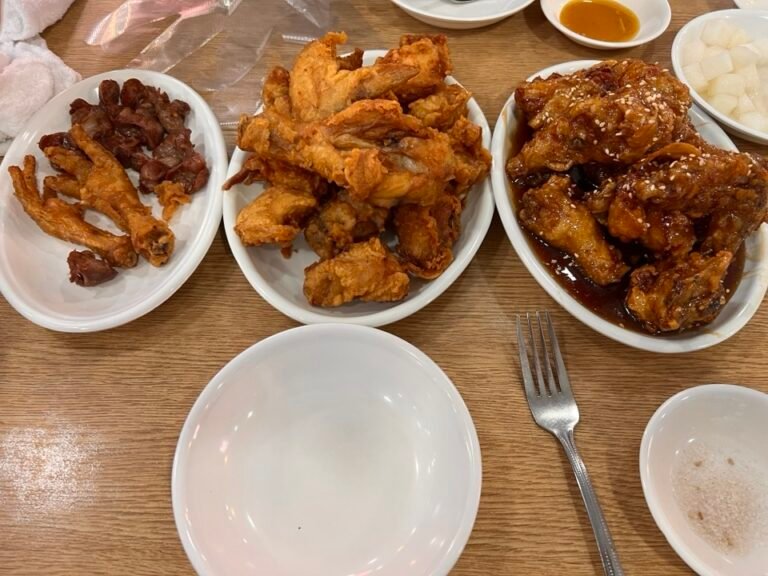
Head back toward Paldalmun and turn into Suwon Chicken Street (수원통닭거리), a short lane by the Suwoncheon stream where restaurants have been frying whole chickens in big iron cauldrons since the 1970s. Order a classic fried whole chicken (tongdak), or the sweet soy-marinated wang galbi tongdak made famous by the 2019 comedy film Extreme Job. Fried gizzards usually come on the side. Expect queues at lunch and dinner on weekends; arriving before 12:30 helps.
A local’s tip: Jinmi Tongdak (진미통닭) is the best-known name on the street and often has the longest line. The restaurants around it serve very similar chicken, though, and most of them are local favorites in their own right. If the queue at Jinmi is long, walk a few doors down and eat somewhere else instead of waiting.
14:00 Hwahongmun Gate and Banghwasuryujeong
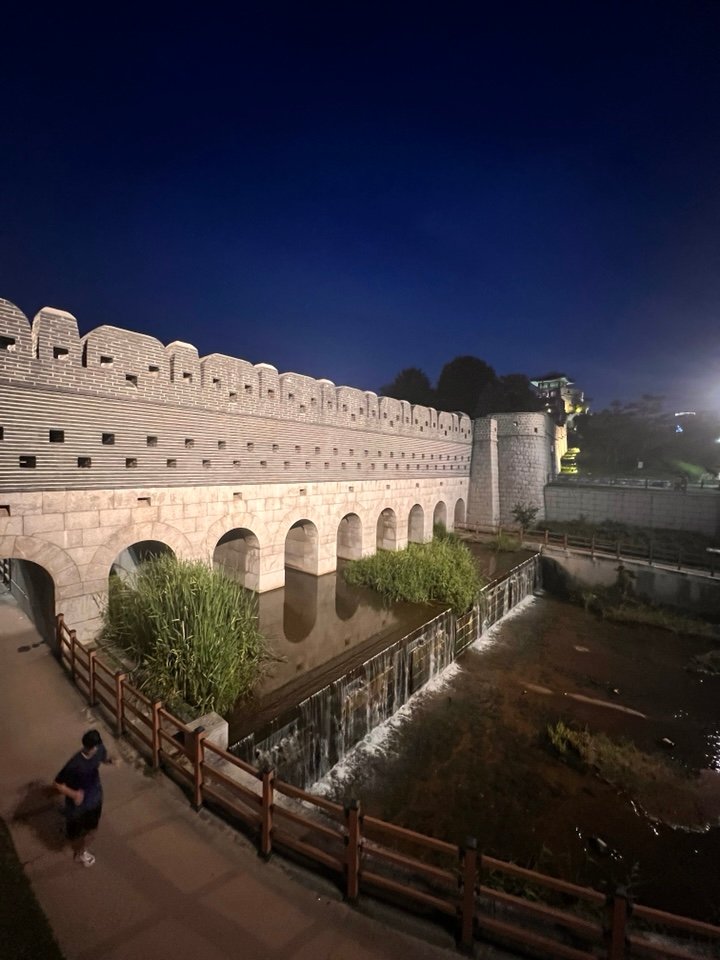
Walk north along the Suwoncheon stream for about 15 minutes to Hwahongmun (화홍문), where the fortress wall crosses the water on seven stone arches. Climb up to Banghwasuryujeong (방화수류정) next to it. Officially a watchtower, it was designed as much for pleasure as for defense, with an irregular floor plan and open sides looking down over the Yongyeon pond. On a sunny afternoon, locals spread out on the grass by the pond. It is one of the best places in the fortress to sit for a while.
15:00 Walk the wall: Janganmun to Hwaseomun
You do not need to walk the full 5.7 km loop, which takes around three hours. The stretch from Hwahongmun west past Janganmun (장안문), the north gate and the fortress’s largest, to Hwaseomun (화서문), the west gate, is the most rewarding hour of the wall: flat, well paved, with watchtowers, gun platforms and views across the rooftops of old Suwon.
If walking is not an option, the Hwaseong Eocha, a small tourist train styled after a royal carriage, loops past the main gates from Yeonmudae with an English audio guide. Adult tickets cost about 6,000 won, and it does not run in rain or snow.
16:30 Coffee in Haengnidan-gil
Step down from the wall near Hwaseomun into Haengnidan-gil, the lanes of the Haenggung-dong neighborhood. Old single-story houses here have been turned into cafes, bakeries and small shops, and because building heights inside the fortress are restricted, the streets keep a low, human scale you rarely find in Seoul. From here, buses back to Suwon Station take about 15 minutes.
Optional: Starfield Suwon at Hwaseo Station
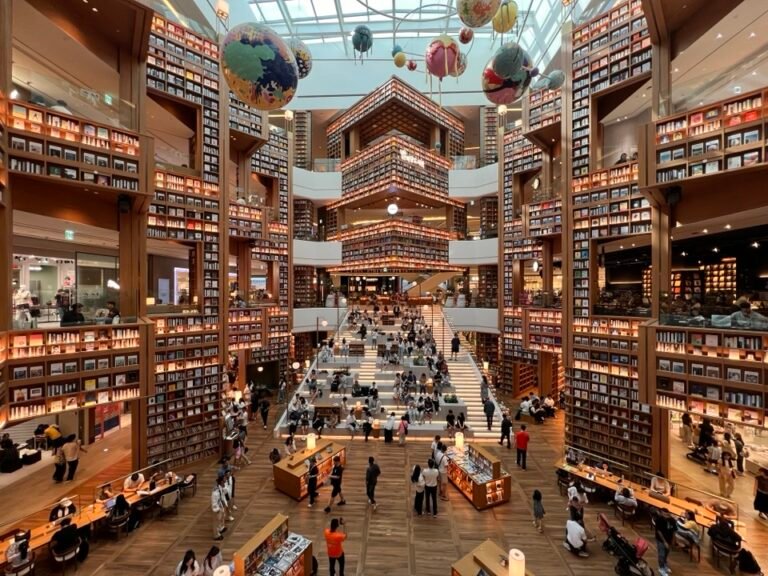
If you still have energy, head to Hwaseo Station, one stop north of Suwon Station on Line 1 and a short taxi ride from Hwaseomun. Right by the station is Starfield Suwon, a large shopping mall that works well as a place to rest your legs and do some shopping before the trip back to Seoul. The highlight is its library space, where towering walls of books rise around you. Being surrounded by that many books gave it an almost mysterious feeling, and I found it a genuinely fun place to spend time.
Staying for dinner?
Suwon is also known for Suwon galbi, large salt-seasoned beef short ribs. The best-known restaurants, often called the city’s galbi trio (Gabojung, Bonsuwon and Shilla Galbi), are outside the fortress, so take a taxi. Afterward, the walls are lit up after dark, and a short evening walk near Hwahongmun is a lovely way to end the day.
Why Hwaseong is worth a closer look
Hwaseong was built in just under three years, from 1794 to 1796, as King Jeongjo’s planned new city. The scholar Jeong Yak-yong worked on its design and introduced a lifting crane (geojunggi) and pulleys that sped up construction. The builders combined stone with fired brick, which was unusual in Korean fortresses at the time, and gave each structure a specific defensive job, from crossbow towers to hidden gates.
What makes the fortress special today is how it was recorded. After construction, the court published the Hwaseong Seongyeok Uigwe, a detailed report with drawings, measurements, materials and even workers’ wages. When parts of the fortress were badly damaged during the Korean War, that record allowed them to be rebuilt accurately, which is part of the reason Hwaseong was named a UNESCO World Heritage Site in 1997. As you walk, look at how the wall follows the land instead of forcing a straight line through it.
Tips for a smooth day
- Wear good shoes. Some wall sections climb steeply, especially around Paldalsan hill on the western side.
- Avoid Mondays if you want to see the martial arts show.
- Bring water in summer. There is little shade on the wall.
- Visit in autumn if you can: early October brings the Suwon Hwaseong Cultural Festival, with a reenactment of King Jeongjo’s royal procession.
- Short on time? Do the palace, lunch and Hwahongmun, then head back. That alone is a worthwhile half day.
Frequently asked questions
Is Suwon worth a day trip from Seoul?
Yes, especially if you like history, architecture or walking. It is close enough that you do not need to plan around train bookings, and it pairs well with a Seoul itinerary such as our 3-day plan.
Is Hwaseong Fortress free?
Walking the fortress wall is free. Hwaseong Haenggung Palace and the Hwaseong Eocha tourist train charge separate fees.
How long does it take to walk the whole wall?
About three hours for the full 5.7 km loop at an easy pace, longer with stops. Most day-trippers walk one or two sections instead.
Do I need a special ticket for the train?
Not for Line 1, which uses your regular transport card. KTX and ITX-Saemaeul need a separate ticket. See our transit card guide to check what your card covers.
For more attraction details, see the official VisitKorea guide to Suwon Hwaseong, or browse more day trips from Seoul.
Information reviewed: November 23, 2026. Fares, train times, palace hours and performance schedules change; confirm them before you travel.